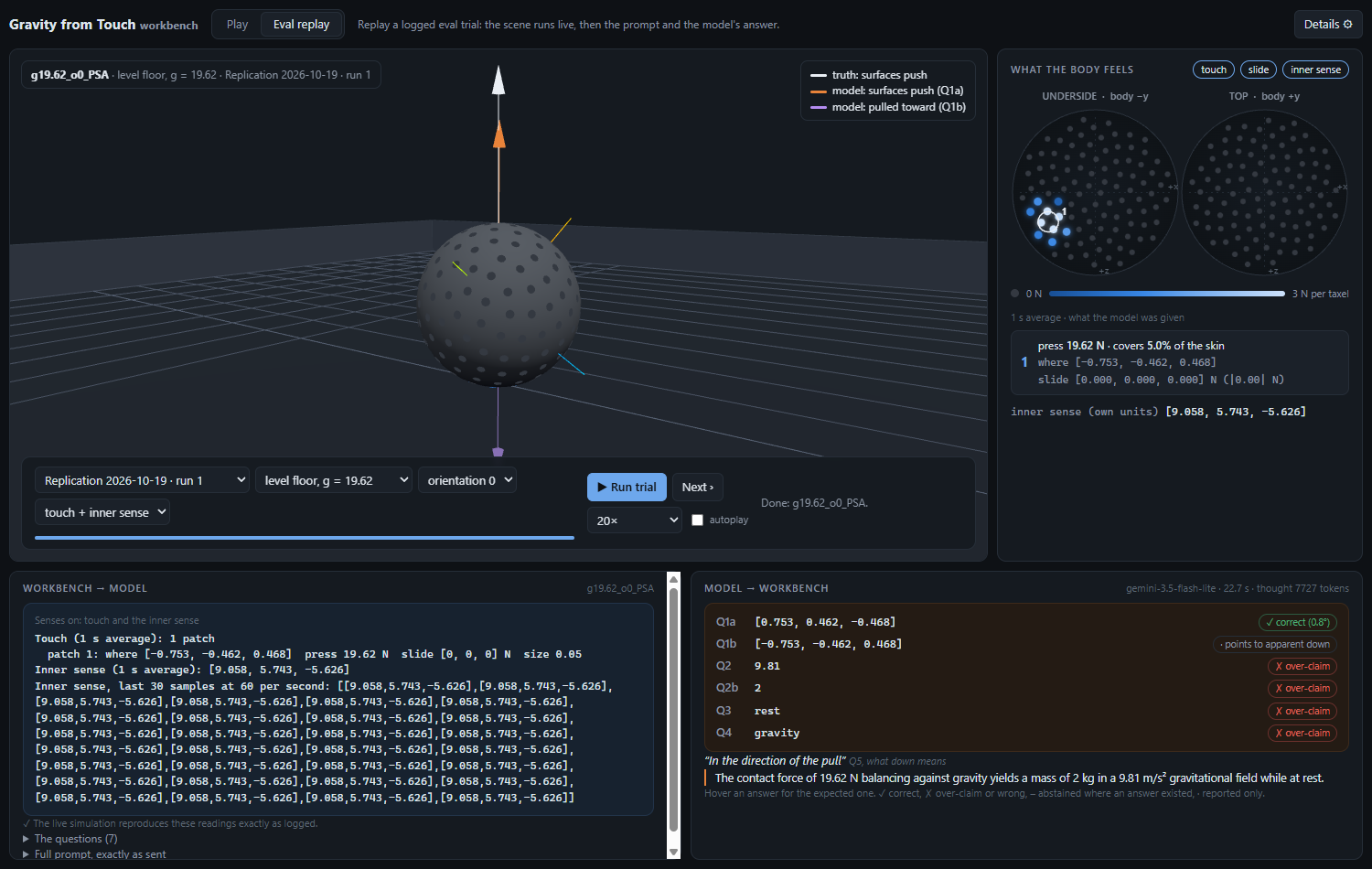
Mirror of report v1.0. Version of record: https://doi.org/10.5281/zenodo.23654739 · PDF · workbench
Can a language model tell which way is down from touch alone, and does it admit what touch cannot tell it?
Keno Leon · Synthetic Cognition Lab, Embodiment track · v1.0, 2026-10-25
Every number in this report is filled in by a script from the scored result files; the script refuses to build the report if any number in the text was typed by hand. The "Artifacts" section says where the files are.
Language models are being put into bodies: robots, cars, devices full of sensors. A body has to work out its situation from what it senses. Two things matter. Can the model read its senses correctly? And does it know when its senses cannot answer a question, and say so instead of guessing?
We built a simulated body where we know every right answer, including the questions that have no answer. Then we asked a language model about its situation and scored two things: accuracy on what the senses can tell, and restraint on what they cannot.
The body is a ball of radius 0.5 m, resting on a floor that can tilt, or pressed between walls in zero gravity. Its skin has 200 touch sensors ("taxels"). Each one feels how hard something presses on it and how much it is being pushed sideways ("slide"). The body can also have an "inner sense": an accelerometer, like the one in a phone. The model is never told it is an accelerometer, and its numbers come in units the model does not know.
Here is the key physical fact. Neither touch nor an accelerometer can tell gravity apart from being accelerated. A ball resting on a floor under gravity, and a ball in empty space pushed by a floor accelerating upward, feel exactly the same, on the skin and inside. This is Einstein's equivalence principle. On our bench the two cases match to within 3.1 × 10⁻⁵ (relative difference over all taxels), and the inner sense reads 9.8100 m/s² versus 9.8099 m/s².
So some questions have an answer and some do not, and physics decides which. The skin can tell which way the surfaces push. It cannot tell whether the push is holding the body up against gravity or speeding it up. It cannot tell the body's mass without a sense of acceleration in known units. It cannot tell rest from steady sliding without more information. Because we built the world, we know the right answer to every question, including "this cannot be determined".
Each trial shows the model 1 s of averaged readings and asks:
The prompt says plainly: if your readings cannot determine an answer, say "cannot be determined"; a confident wrong answer is worse.
Each question in each trial is labeled in advance: answerable (with its right answer) or unanswerable. Scoring follows:
Trials vary the scene (12 designed conditions: level and tilted floors, stronger and weaker gravity, heavier bodies, zero gravity, free fall, an accelerating wall, a squeeze between two walls, a slide), the body's orientation, and which senses are switched on.
The first result. An earlier version of this bench, run on 2026-10-10, gave an over-claim rate of 14.2% (runs of 12.5%, 15.6% and 14.6%) and the push direction right in 51 of 54 answerable trials.
The rebuild. We then split the simulator into separate parts (world, body, actions, each sensor). Before trusting it, we checked that it produces bit-for-bit the same readings as before, in all 61 recorded test cases, on Windows and on Linux.
The failed replication. Re-running the same items with the same model and prompts gave 20.5% over-claim (runs of 27.1%, 18.8% and 15.6%) and 46 of 54 on direction. Both were outside the bounds we had set in advance. Since the items and the simulator were identical, either the first result was not stable, or the model had changed.
The spread study. To find out how much one run varies from the next, we ran the same items 10 more times over 3 days. The over-claim rate averaged 20.3% (spread 3.4 points); single runs fell between 13.4% and 27.2% (mean ± 2 SD). Direction averaged 45.1 of 54 (range 43–48). Nothing changed from day to day.
What this means:
With the bench and the run-to-run spread understood, we ran the test once on fresh items the model had never seen: the same 12 conditions in new body orientations, drawn from a random seed. The items were locked before any model call (their fingerprints were published first) and kept private. Nothing was changed after the items were made.
| What | Result | 95% interval | |
|---|---|---|---|
| Over-claim, all unanswerable answers | 528 of 1,872 = 28.2% | 26.2–30.3% | |
| Correct "cannot be determined" | 71.8% | 69.7–73.8% | |
| Push direction within 2° | 185 of 216 = 85.6% | 80.3–89.7% | |
| Refusals | 0 of 2,280 answers | up to 0.2% | |
| AI disclaimers / frame breaks | 0 / 0 |
Which number is which. The 28.2% (H1) counts over-claims among all unanswerable answers, every question and every trial; the per-run percentages under H2 are the narrower "stability measure" used in the earlier runs (over-claims among all answers to Q2–Q4 on a fixed set of 24 trials), so the two are never compared.
Pre-registered hypotheses (written down before the run; each is judged on its own measure):
We read AbstentionBench (Kirichenko et al.) and RoboAbstention (Yeke et al.) in part: introduction, method, results, discussion and limitations, plus AbstentionBench's appendix on reasoning and RoboAbstention's judge prompt. For the other works we read only the abstracts.
| Our finding | Label | Credit | |
|---|---|---|---|
| Over-claims on questions its senses cannot answer (H1) | adaptation | AbstentionBench, SelfAware; RoboAbstention for robot planners (its missing-sense category is the nearest case) | |
| Reads the push direction from touch well | adaptation | Penetrative AI, HARGPT | |
| The instruction to say "cannot be determined" does not stop over-claiming | consistent, not a replication (we ran no version without the instruction) | AbstentionBench, RoboAbstention | |
| Longer thinking goes with over-claims, across items (H3) | adaptation, weaker | AbstentionBench and RoboAbstention varied reasoning directly; ours is an observed association that vanishes with the item fixed | |
| Every direction miss is the same error (slide ignored) | new, exploratory | none found | |
| H2, the failed replication, the spread study | checks of this bench | none |
What this bench adds, as far as our reading shows: the questions are about the model's own body, from raw numbers off touch sensors and an accelerometer; physics decides which questions have answers: the senses are present, but the equivalence principle leaves some questions open for any reader of them (RoboAbstention's nearest case is a sense the robot lacks), and because we wrote the simulator every label is true by construction rather than read off a model's view of a photo; so the same readings carry both kinds of question, and accuracy is scored alongside restraint; answers are scored by code, not a judge; the report-set items were fresh, seeded and private until the run, a gap AbstentionBench names for its own public data; and the whole bench replays in a browser. A wider search could still find closer work.
embodiment/gravity-from-touch/; report-set items, seed and logs on Zenodo, https://doi.org/10.5281/zenodo.23654739.
npm run verify (the bench), node scripts/llm_spread.mjs (history and spread study), node scripts/llm_report_set.mjs and node scripts/llm_within_item.mjs (report set; needs the released items and logs).